
An old walking map (1) of the Great South West Walk, is marked with a “McEachern Cave” on the river bank north of Nelson. I looked for it but gave up. Later, when I got to know Leila Huebner, I asked her about the cave. She told me that there were in fact three caves north of Nelson and they had all been surveyed.
A web search quickly revealed the caves – Amphitheatre Cave (2), McEacherns Deathtrap Cave (3) and McEacherns Cave (4). All are classic “pitfall” caves into which animals and birds have fallen over long periods.
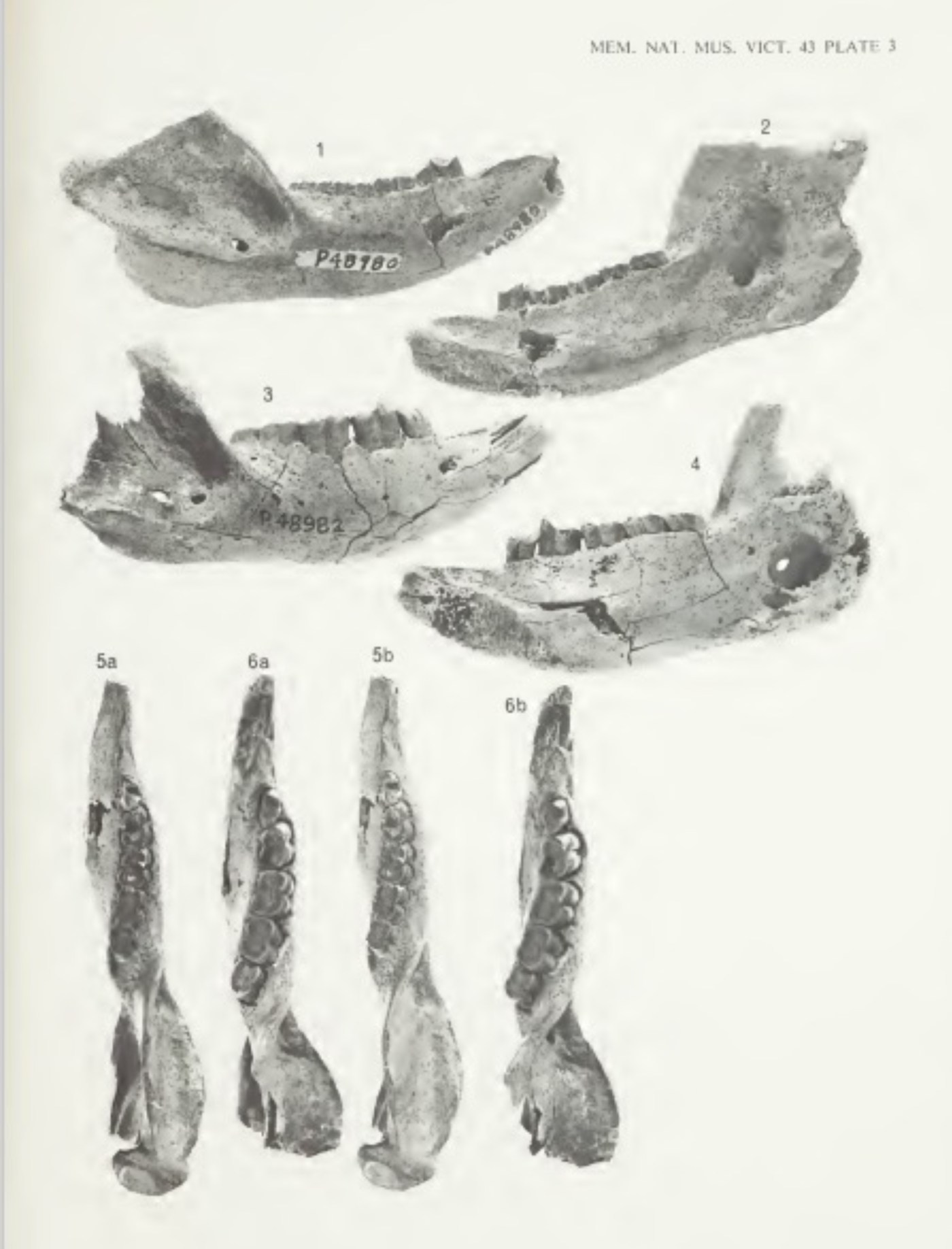
McEacherns Cave contained an important paleontological find – Warendja wakefieldi, a newly identified genus of wombat from the Pleistocene era or Ice Age. The words Ice Age immediately conjure up a huge lumbering dinosaur wombat. Not so, Warendja was quite a little guy, say 10kg (5). According to JH Hope & HE Wilkinson.(4),”The mandible is remarkably smaller and more delicately built than in all other known vombatids”.
Here is the history of the find (4).
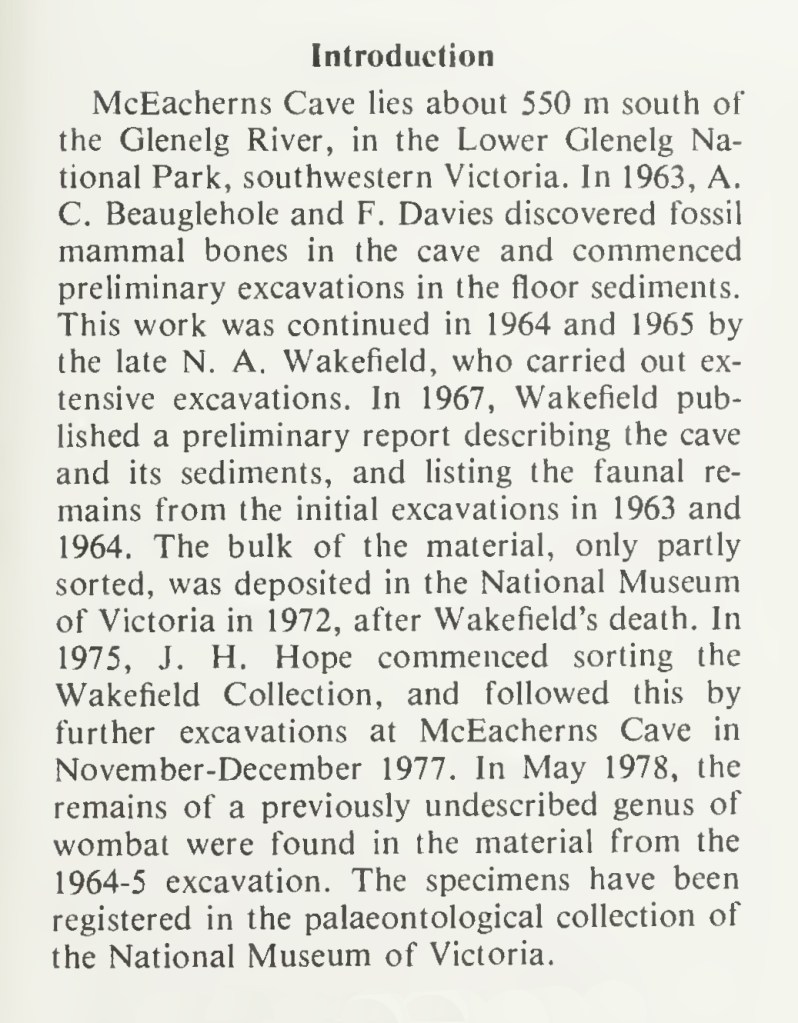
The A.C. Beauglehole referred to is none other than Cliff Beauglehole OAM who was an extraordinary botanist and conducted field surveys throughout the South West. It seems these Field Naturalists get up to it all.
Wakefield’s biography is also impressive (6). The sad reason he was unable to sort his collection from the McEacherns Cave was his early death at 53 in a fall from a tree while lopping branches in his garden.
The main question remaining for me now is why aren’t there any wombats this side of the river? There used to be.
REFERENCES
1. Probably pre-1990s. Text compiles by Officers of the National Parks Service. Printed by E.Davis & Sons Pty.Ltd, Portland.
2. https://journals.australian.museum/baird-1992-rec-aust-mus-441-2144/
4. Hope, J H; Wilkinson, H E. “Warendja wakefieldi, a new genus of wombat (Maruspialia , Vombatidae) from Pleistocene sediments in McEacherns Cave, western Victoria”. https://museumsvictoria.com.au/media/5136/jmmv19824308.pdf
6. https://en.wikipedia.org/wiki/Norman_Arthur_Wakefield
Words by M Styles
 Nelson Coastcare